Gooten may be a perfect match for your business. Contact our sales team today to find out!

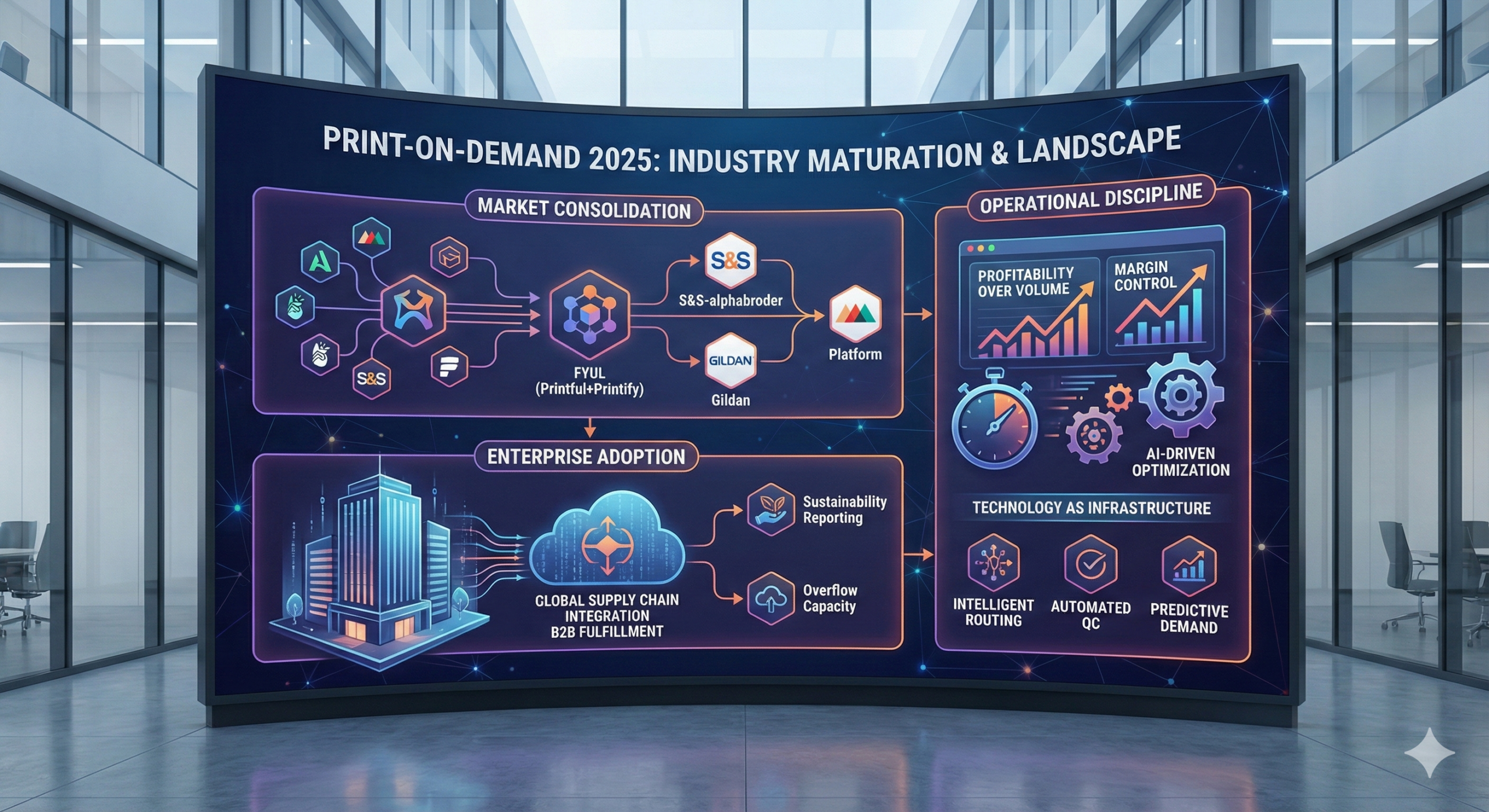
In January 2025, we outlined key predictions for the print-on-demand industry: continued consolidation, AI’s operational evolution, B2B market expansion, and the maturation of social commerce. Twelve months later, it’s time to assess those predictions against what actually happened and what will shift in 2026.
Last year’s outlook anticipated continued pressure from slower consumer demand following the pandemic boom. That prediction proved accurate, but the reality was more nuanced than expected.
Growth didn’t vanish: it shifted to more disciplined operators. The era of easy money in print-on-demand ended decisively in 2025. Businesses without a clear niche, distribution advantage, or operational rigor struggled to survive. The market didn’t rebound to COVID-era growth rates. Instead, it matured, sorting out which companies had the operational foundation to grow in a more challenging environment.
This trend will intensify in 2026. The industry continues maturing, creating genuine opportunity for scaled, disciplined operators while widening the gap between professional operations and smaller, undercapitalized players.
New dynamics are emerging that will define the competitive landscape:
Technology and scale have evolved from competitive advantages to survival requirements. Economics are forcing maturity. The platforms that will win are those that make profitability visible and controllable, not just enable production.
My 2024-2025 outlook predicted more mergers and roll-ups, noting that scale would require multi-facility footprints and stronger balance sheets. That forecast proved true.
The Printful-Printify merger (now FYUL), announced in late 2024, continued reshaping creator commerce economics throughout 2025. The S&S-alphabroder combination set new baseline expectations for distributor scale. But the M&A activity didn’t stop there:
Smaller fulfillers in print-on-demand increasingly faced a binary choice: exit, specialize, or partner. Independent competition became unsustainable for all but the most differentiated players.
The consolidation wave will continue into 2026, but its nature is changing. COVID-era investments are maturing, and private investors are seeking exits in an IPO environment that doesn’t support them. I expect large M&A activity, particularly PE-to-PE deals involving major portfolio companies:
The next wave of consolidation will be about portfolio rationalization and return optimization, not market entry.
Last year’s analysis correctly identified that corporate and enterprise buyers would lean into print-on-demand, though it noted that technology would need to catch up. That’s exactly what happened.
Enterprise B2B adoption of print-on-demand accelerated meaningfully in 2025, driven by global expansion requirements, overflow capacity strategies, product extensions without inventory risk, and sustainability reporting requirements.
New technology platforms supporting POD in promotional products and B2B contexts—like Ciloo—provided the infrastructure that enterprise buyers demanded.
Print-on-demand is no longer just for eCommerce businesses and creators. It has become a legitimate supply chain strategy for enterprise operations.
For 2026, expect corporate buyers to demand even more sophisticated infrastructure:
Technology platforms that serve these B2B requirements will capture disproportionate value.
The 2024-2025 outlook anticipated continued alignment between print and promotional products markets. This prediction materialized clearly in 2025.
Promotional products distributors embraced on-demand models more seriously. Company stores combining traditional inventory with POD gained traction across corporate buyers. Print-on-demand became the bridge between traditional print economics and modern eCommerce expectations.
The walls between print, promo, and eCommerce have effectively disappeared in the US market. For 2026, this convergence will expand globally, starting with the UK. European distributors will adopt hybrid models combining traditional inventory with on-demand production, following the path the US market has already traveled.
Gooten may be a perfect match for your business. Contact our sales team today to find out!
Last year’s predictions expected TikTok Shop to become a major force and social selling to outpace traditional eCommerce growth. The reality proved more complicated.
TikTok Shop continued performing despite policy uncertainty, but it hasn’t been the print-on-demand powerhouse initially anticipated. Sellers who mastered the trifecta of content, conversion, and fulfillment reliability succeeded. Platform volatility forced brands to diversify beyond single social channels, a painful but necessary evolution.
Social commerce is real, but it remains early in its development cycle. For 2026, expect social commerce and fast-fashion marketplace platforms to recognize print-on-demand’s potential more explicitly. These platforms will likely build POD-specific features: native customization tools, integrated production networks, and creator-friendly merchandising capabilities.
The 2024-2025 outlook predicted that AI’s biggest impact on print-on-demand would extend beyond generative design into customer service, production optimization, demand prediction, and quality assurance. This forecast was directionally correct but optimistic on timing.
AI-assisted creative became table stakes in 2025. Operational AI adoption progressed more slowly than anticipated but made meaningful inroads in quality control and customer service automation. Technology is transforming the industry; the question is pace, not direction.
For 2026, AI tooling will emerge natively in technology platforms across print-on-demand. AI-powered product optimization will dominate marketing conversations. Agentic shopping—AI systems that browse, select, and purchase on behalf of consumers—will open new opportunities for personalized print products. The operational AI revolution predicted for 2025 will begin materializing in 2026.
Last year’s analysis expected new software platforms to emerge and predicted increased focus on efficiency and control over simple catalog breadth. This proved accurate.
Gelato Connect, Fulfill Engine, commonsku, OrderMesh, and other technology platforms gained meaningful traction in 2025. Brands increasingly evaluated POD vendors based on technical maturity rather than product catalog size. Shopify solidified itself as the default commerce layer for POD-driven brands.
The future of print-on-demand runs through infrastructure, not marketplaces alone.
For 2026, competition will intensify among software players. The winners will be platforms that reduce operational complexity while increasing visibility and control, while delivering on enterprise-grade scale and security requirements. Expect further consolidation as larger players acquire promising technology to fill capability gaps.
Looking back at last year’s predictions, several themes proved accurate, even if the timing was occasionally early:
Trade policy and geopolitical impact continue creating uncertainty for global fulfillment networks. Tariff changes, supply chain nationalism, and geopolitical tensions make long-term planning difficult.
Antitrust enforcement represents another wild card. Regulatory scrutiny of large platforms could reshape competitive dynamics, particularly for recently consolidated players.
Political shifts, including the 2026 midterm elections, could influence trade policy, labor regulations, and economic conditions affecting print-on-demand.
2025 wasn’t a breakout year for print-on-demand. It was a sorting year.
The industry grew up. The winners weren’t louder, cheaper, or broader. They were faster, more reliable, better integrated, and more disciplined.
As the industry moves into 2026, success will require operational excellence, technological sophistication, and strategic clarity. The infrastructure companies build today determines their competitive position tomorrow.
The print-on-demand industry is no longer forgiving of inefficiency. The opportunity exists for those prepared to meet the moment with the capabilities the market now demands.
Gooten may be a perfect match for your business. Contact our sales team today to find out!
Maddy Alcala
Maddy Alcala, President at Gooten. Maddy oversees the entirety of Gooten's go-to-market organization, ranging from marketing to customer service, and cites her favorite part of her job as working with her incredible team that supports clients of all sizes, from small startups to the world's largest brands across marketplaces, retailers, and manufacturers.
Subscribe for
exclusive updates
Be the first to know about our latest
product additions and pricing offers.
JOIN OUR NEWSLETTER
Get our latest news and updates.